Insights
How to follow up on declined work without blasting your list
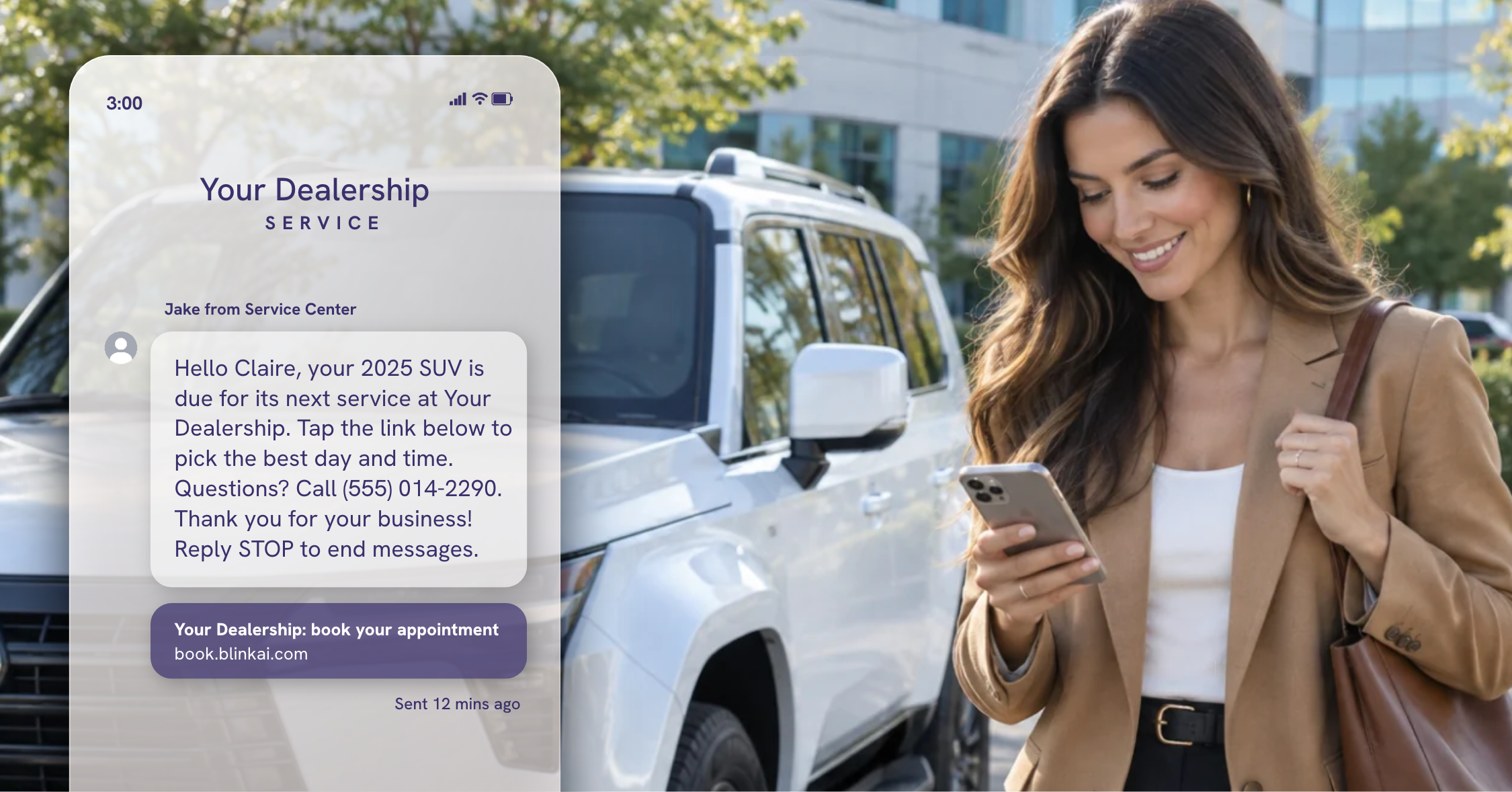
Target declined work by item and timing, then send each customer a message with their name, their vehicle and the work the tech found, plus a booking link that's already filled in. You can send to thousands of customers at once, as long as each message reads like it was written for one of them. A generic reminder listing everything declined in the last 90 days, with no easy way to book, reads as noise.
Picture one of your customers at the counter at 7:40 AM on a Tuesday... or even better, a close family member. They came in for an oil change. The advisor walks over with the MPI: front brakes at 4mm, a cabin filter, a coolant flush. They have a 9:00 AM meeting and a car budget that's already spent this month. So they say "not today" to all three.
And what they meant was just that, not today. So your dealership starts to send texts, about all three items, then an email with all three items, then the same text again next week. By the third one, they've stopped opening anything from the store, including the recall notice you'll send in March.
Every message went out, so on paper the follow up is done. The box is checked. But nobody booked the brakes. So what's really behind that "not today"?
Why do customers decline recommended work?
Most customers decline because of time, money or doubt, and the service counter is a hard place to settle any of the three. They want to know what it costs, whether it can wait, and whether they really need it.
The Cox Automotive 2025 Service Industry Study (November 2025) shows what's on their mind. Among owners who had a frustration with service:
- 13% said the provider tried to push additional services
- 13% said it was hard to find out how much they charge
- 12% said the final price came in higher than the estimate
The same study found 55% of owners say it's very important to be able to compare costs online. A customer who declines the brakes is often doing exactly that: checking the price, checking the budget, or checking with someone at home.
And the price gap many customers expect usually isn't there. Dealership repairs averaged $261 in 2025, compared with $275 at general repair shops (Cox Automotive 2025 Service Industry Study). Cox calls the belief that dealers cost more a misconception that holds customers back. A follow up with the price right in it answers the question they were about to go ask somewhere else.
That makes a decline a "later" more often than a "no." The follow up decides which one it becomes.
What does a blast actually cost you?
A blast sends the same reminder to everyone and leaves the customer to figure out what to do next, so it reads as noise, and each opt out removes that customer from every future reminder.
Here's how it adds up:
- Nothing to act on. A message that only informs ("you have open service needs") asks the customer to find the number, call, and explain it all again. Most won't.
- Customers tune out. When wipers and brakes get the same urgent message, customers can't tell what matters, so they ignore both.
- Opt outs are permanent. A customer who replies STOP to a declined work text also stops getting service due reminders and recall notices.
- Big repairs turn into trade decisions. Cox found owners start weighing a trade in over a repair at about $3,195, and over half of owners facing a big repair say they might trade (Cox Automotive 2025 Service Industry Study). A clumsy follow up on a big declined repair can send that customer to another store for both the repair and the next car.
Satisfaction is what brings them back. In the J.D. Power 2026 U.S. Customer Service Index Study (March 2026), 86% of mass market and 88% of premium customers with very high satisfaction scores (950 or more) say they definitely will return for paid service.
What are dealers trying today?
Most stores run some mix of advisor callbacks, a BDC working the declined services report, and an automated declined services campaign. Each one works somewhere and stalls somewhere.
| Approach | Where it works | Where it stalls |
|---|---|---|
| Advisor calls a few days later | Personal; the advisor knows the car and the customer | The advisor is at the counter, and calls slip when the drive is slammed |
| BDC works the declined report | Consistent and tracked | Long report, one script for every item, calls during the customer's workday |
| Automated campaign to everyone with a declined line | Reaches everyone | Same message for every item, no timing, links to a phone number or the homepage |
None of these is wrong. What's usually missing is the match between the item, the timing and an easy way to book.
What makes declined work follow up work?
Target the right customers, personalize every message, and make the link do the booking. Here's what that looks like in practice.
- Target by what was declined. Brakes and tires are their own group, with a prompt, short note. Filters and flushes can wait for the next service reminder.
- Target by the reason they gave. Group customers by why they said no: the budget, wanting to think it over, or waiting for the next visit. Each group gets a message that fits its reason, sent on the timing your OEM and dealer group guidelines call for. "Next visit" can ride along with the next service reminder instead of its own message.
- Personalize every message. Use the customer's first name, their year, make and model, the item, and what the tech measured. The send can go to hundreds of customers; each message should read like it's about their car.
- Show the finding. Attach the photo the tech took. J.D. Power's 2026 CSI Study found satisfaction with the service advisor is highest when customers get photo or video evidence (928 premium, 907 mass market) and recommends making it routine.
- Put the price in the message. Customers want to compare. Give them the number so they don't have to call for it.
- Send a personalized booking link. The link should open with the customer's name, vehicle and the declined service already filled in, so all they do is pick a time. Skip the homepage, the login screen and the blank form.
- Send to the customers you're targeting, not the whole list. If a customer isn't a fit yet, hold the message until it's relevant. That keeps your texts worth opening.
- Stop when they book, and stop when they ask. Send only to customers with consent on file for that channel, and honor a stop reply right away.
- Bring sales in on big repairs, gently. When a repair crosses the point where a customer might trade, offer an appraisal only if they want one.
A message built this way reads like it came from someone who knows the car:
Hi Maria, it's Jake at [Store]. When your [YEAR MAKE MODEL] was in on the 4th, the front brakes measured 4mm. Here's the photo. Front pads and rotors are [PRICE]. Want to grab a time this week? [PERSONALIZED BOOKING LINK]
Her name, her car, one item, one photo, one price, and a link that's already filled in. Maria can book it on her lunch break.
Where does BLiNK fit?
Outreach sends declined work campaigns to targeted customer lists on consented text and email, and every message carries a personalized booking link with the customer's name and vehicle already filled in. Across stores using it, an average of $23K per store per month in service revenue was processed through Outreach (BLiNK platform data, January to September 2026). Outreach handles the targeting, the timing and the link.
Outreach gets the right message to the right customer, and it performs well on its own. But it's one step. What happens after the customer replies is where the relationship gets built, and that's where Engagement Hub comes in.
Every text, call and campaign reply lands in one inbox your whole service team works from, with an owner on every conversation. When Maria writes back asking what the brakes will really cost, her advisor tags parts right in the thread and gets pricing back in seconds, ready to send. She gets her answer while she's still comparing, and your advisor spends their time on the part only a person can do.
Engagement Hub also shows every message that's gone out to each customer and whether they replied. If someone writes back that they sold the car, your team sees it right in the thread and can stop the reminders. Easy gets them back once. Connected keeps them for life.
We give dealerships what they need, so they can give their customers what they want.
FAQ
What should a declined work text include?
The customer's first name, their vehicle, the item, what the tech found with a photo, the price, and a booking link with their details already filled in. One item per message.
Should declined work follow up come from the advisor or the BDC?
The message should read as if it came from the advisor who saw the car, with their name and the store's. Who presses send matters less than whether the message names the item and what the tech found.
Is it OK to text customers about declined service?
Yes, when the customer has consent on file for texts from your store. Honor stop replies right away, and check your process with your compliance team.
Can you send declined work follow up to your whole list at once?
You can send at scale, but target first: by the item declined, how long ago, and the reason. Each message should carry the customer's name, vehicle and the item, with a link that books it.
How do you measure declined work follow up?
Count booked appointments and opened ROs that include the declined item, by item type. That tells you which messages and timing bring customers back.
See how Outreach follows up on declined work
Sources
- Cox Automotive 2025 Service Industry Study, November 2025 (survey of 1,974 vehicle owners, April to May 2025): frustrations 13%, 13%, 12%; trade consideration at about $3,195
- Cox Automotive press release on the 2025 Service Industry Study, November 11, 2025: 55% say comparing costs online is very important; over half facing a big repair might trade; dealership repairs averaged $261 vs $275 at general repair shops in 2025
- J.D. Power 2026 U.S. Customer Service Index Study, March 12, 2026: advisor satisfaction 928 and 907 with photo or video evidence; 86% and 88% definitely will return at 950 or more
- BLiNK platform data, January to September 2026, all brands: $23K per store per month processed through Outreach